

Part 5...
That stories have a beginning, middle and an end suggests they are linear.
This goes completely against the grain when it comes to interactive media.
Our stories are non-linear. Hit a web site, for example, and the odds
are fairly good that you will be dropped into the middle of the story.
As interactive media developers it is our responsibility to ensure that
the visitor dropped into the middle of the conversation instantly knows
what we are talking about. Thus the importance of the brand.
Go to the Cocoa Cola site and you will see Coke Red. Hit Disney and you know you are there because the Disney brand is simply so universal. Same thing goes for this company.
 Don't
for a minute think the great dot com meltdown resulted from billions
of dollars funding thousands of bad ideas. I got into this discussion
with an older gentleman who asked me during question period after a speech
why I am training my students for unemployment. "Sir", I said, "the stock
market is not the economy." The reason these companies went down the
tubes was due to a fundamental inability to tell their company story.
What do gerbils being shot out of cannons and trained chimps in garages
tell us about a company and its products? Interactive media companies
disappeared not because they weren't great. It was because, in many cases,
they couldn't articulate their client's story and the client simply found
someone else who could.
Don't
for a minute think the great dot com meltdown resulted from billions
of dollars funding thousands of bad ideas. I got into this discussion
with an older gentleman who asked me during question period after a speech
why I am training my students for unemployment. "Sir", I said, "the stock
market is not the economy." The reason these companies went down the
tubes was due to a fundamental inability to tell their company story.
What do gerbils being shot out of cannons and trained chimps in garages
tell us about a company and its products? Interactive media companies
disappeared not because they weren't great. It was because, in many cases,
they couldn't articulate their client's story and the client simply found
someone else who could.
We are also starting to see stories developed on the web diffuse to other media. Here's an example:
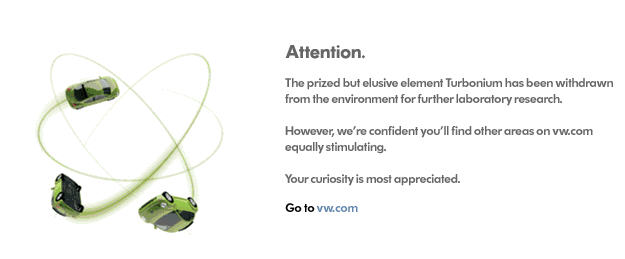
The company that developed this site a couple of years ago looked at a single feature of the Volkswagen, turbo power, and decided to build a story around it. The story is the discovery of a new element- Turbonium. This year I actually saw a turbonium ad on TV and heard a Turbonium ad on the radio. This suggests that nothing can stop the power of an excellent story.
David Jones is Austalian. Here is an example of his work that underlines my next point when it comes to telling a great story:
 The
beauty of this piece is drawn from the story. It is a great story of
love and romance, with a twist. It is also done in Flash, whose main
strength, is the ability to tell a linear story. What makes this story
work so well is not the underlying technology. It is the characterizations.
It is the creative tension- Will she get the flowers? Will they fall
off of the mountain? These are the hallmarks of a great story and they
are no different from those of the Innu or Wayson Choy.
The
beauty of this piece is drawn from the story. It is a great story of
love and romance, with a twist. It is also done in Flash, whose main
strength, is the ability to tell a linear story. What makes this story
work so well is not the underlying technology. It is the characterizations.
It is the creative tension- Will she get the flowers? Will they fall
off of the mountain? These are the hallmarks of a great story and they
are no different from those of the Innu or Wayson Choy.
Sometimes you are simply handed the story and asked to make something from the literate tradition have just as much appeal in the oral tradition. If you have ever been to a poetry reading you will discover that the poet can make the poem more vivid and compelling than were you to simply sit in solitude and read the poem from the printed page.
Moving media from one tradition to the other is extremely difficult if not impossible. It can be done and done well if you approach the story from the oral tradition and look for areas where the strengths of the technology add power to the written word.
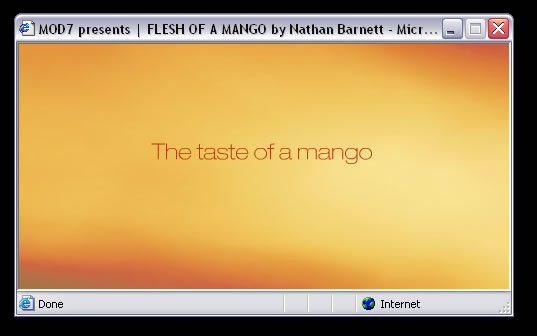
There is a 'zine out of the U.S.- Born Magazine- which, each month asks a digital artist to bring a poem to life. One of my favorites is this one, "Flesh of a Mango":
 In
this example the technology is used to its fullest. The imaging is dead
on. The sound is amazing and the typography is excellent. Yet what makes
this piece so compelling is not the technology. What makes it so compelling
is the fact the technology is so transparent. You pay attention to the
story, not the underlying technology that, by the way, is flash-based.
In
this example the technology is used to its fullest. The imaging is dead
on. The sound is amazing and the typography is excellent. Yet what makes
this piece so compelling is not the technology. What makes it so compelling
is the fact the technology is so transparent. You pay attention to the
story, not the underlying technology that, by the way, is flash-based.
For a story to work, the audience must focus on the story. Not the storyteller. Let me tell you a story about that one.
A few years ago, when Flash was new somebody figured out how to create a rotating globe using Flash. The source code was posted to the Flash list and the next thing you knew, spinning globes were showing up everywhere. A Flash developer in Dayton, Ohio, asked for a review of a site he had just completed for one of his clients. Guess what was on the right side of the web page? I had had my fill of these and told the developer how much it "sucked."
He read my review and, in the Flash list, proceeded to let loose with
a primal scream that started with "Just who the hell was I to criticize
his masterpiece?" and finished with his calling my parentage into question.
Well, he called me a "Bastard."
Rather than get into it with him I asked a series of very
simple questions:
I live in Toronto, can I buy a set of tires from his client? No.
What about someone that lives in Kuwait? No.
How about someone in a neighboring state? No
Then why the spinning globe? It tells me the company is global in scope and you are telling me it isn't.
Turns out they mainly supplied auto dealers and garages in Dayton, Ohio with tires. The globe was there because the developer learned how to do it and thought he would tell his peers, "Aren't I clever?" What he didn't expect was one of them to tell him he really wasn't all that clever because the globe had nothing to do with his client'
A fascinating twist on the telling of a story is giving the user the opportunity to choose how the story is told. CSS Zen Garden does this quite well by allowing the user to make that choice.
In this case, it is simply the same story- here's what we can do for you- but the user, to use a print analogy, can choose one of multiple editions of the same book.
Stories are the key to our ability to communicate. We are hard-wired into the process- whether we are the ones telling the stories or those listening to them. In many respects there are very few differences between the Age of Exploration when Europeans discovered there was more to world than their small slice of it and today's exploration of cyberspace. In both instances the voyagers returned with stories of what they had seen. Is there really any difference between the notation on an old map where the edge of the known world is shown with the legend on the other side of that line "There be dragons" and "You gotta check out this cool site ... "?
What makes stories so interesting is not the story. It is the interaction that takes place when we share them with each other. Your choices in this interaction are rather interesting: You either relate to the story and respond or you don't. At the beginning of this lecture I told a story and you decided how you would interact with me. What we really did was to form or alter the relationship between us. If you are good at it- telling stories - you will have the opportunity to impact someone either positively or negatively.
A story's strength lies not only in its content and context but also in its presentation. This means you must master the medium and you can only do this by totally understanding the medium.
For the Innu story the medium was oral. It used the Innu language. The storyteller used inflection and emphasis to tell his story. In the North American Aboriginal culture the most powerful people are the storytellers. They have the most stories to tell to the most people.This tradition is now a part of your tradition. You, as a story teller have the opportunity of not only reaching the most ears (or eyeballs)but also telling the most stories. Don't get arrogant with that last one. It is the quality of the story, not the quantity that is most important here. If your stories have no relation to the listener and there is no reaction, all of your power is lost.
Whether it be film, television, radio, newspaper, a book, music, digital imaging or the internet a story is only as effective as one's mastery of the medium. Josh Ulm in a presentation at FlashForward 2001 this past June explained it beautifully when he said. " Each medium tells its story differently and can tell a compelling and engaing story if you let the medium use what it does best. "
The most effective piece of Television I have ever seen was the night of the start of the Gulf War in the early 1990's. Bernard Shaw was in a hotel room in Baghdad and he simply stuck the camera out the window of his hotel room and let the camera roll. I was simply spellbound listening to the air raid sirens and watching the tracer shells of the antiaircraft guns fly across the Baghdad skyline. What made it even more compelling was the fact the correspondent simply said nothing. He let what the camera "saw" tell the story.
Contact:
Downloads:
Books and Links:
Storytelling on the web "Amazoning" the newsThe case for web storytelling
Interview with peter Lunenfeld
Inuuit Traditional Knowledge Site
Innuit Video
The Experience Economy
RemediationCampfire stories